
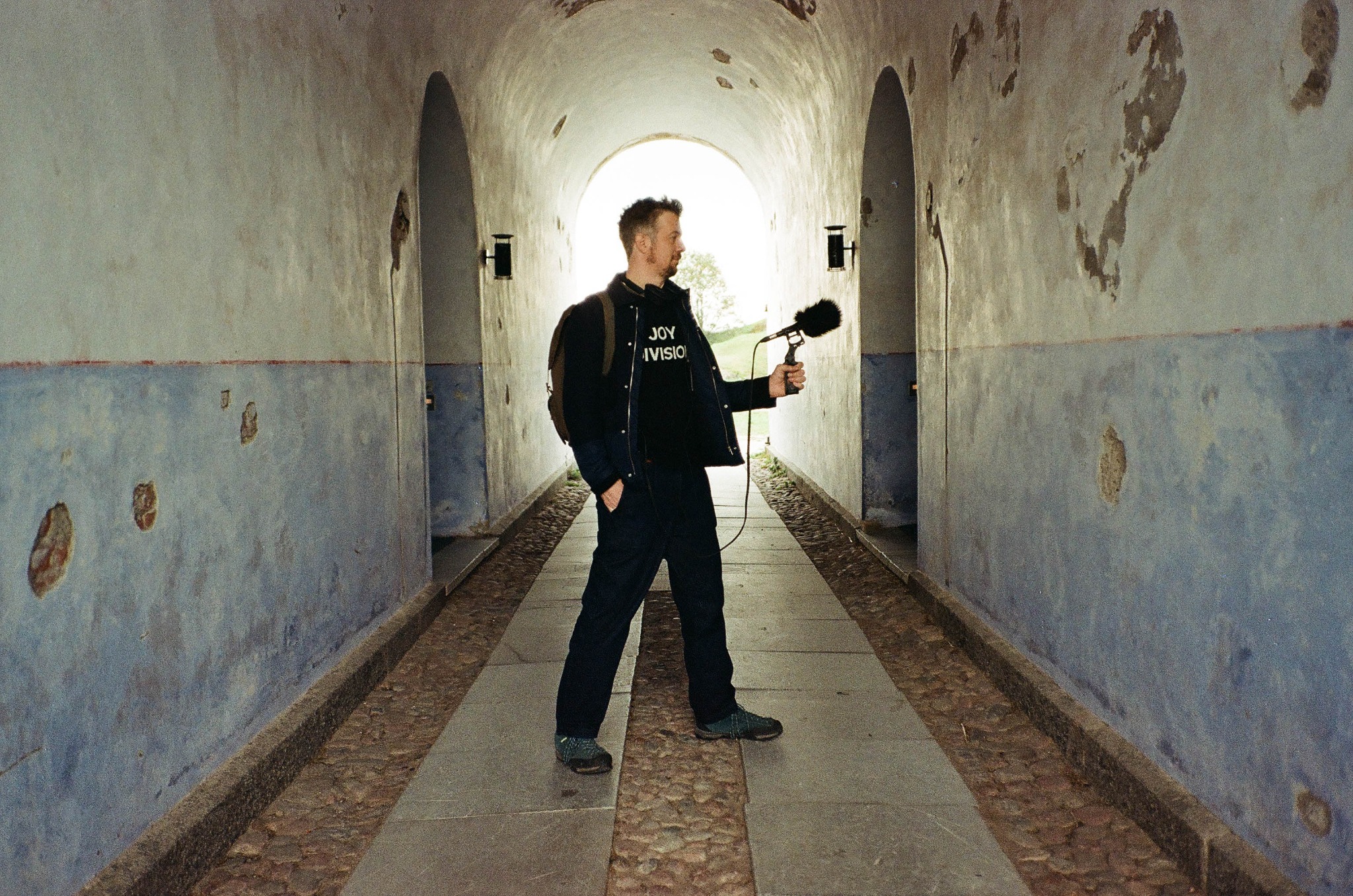
Stuart Fowkes, on listening
Follow your ears. A listening walk with Stuart.
Stuart Fowkes, founder of Cities and Memory, on field recording, memory and learning to listen differently.
Stuart Fowkes is a sound artist and field recordist from Oxford, UK, and the founder of Cities and Memory. He created the project in 2015, after more than 15 years of using field recordings to give context to musical composition.
Cities and Memory brings together field recording, sound art and composition to explore place and memory through sound. Its global sound map places the original recording of a location beside a reimagined composition created from it. The project now covers more than 140 countries and territories, with more than 8,000 sounds and over 2,500 contributing artists. Fowkes has recorded many of the sounds himself, produced reimagined compositions and curated contributions and partnerships from around the world.
Stuart Fowkes in conversation with Listen Closer
What was your first ever recording?
Lost in the sands of time—probably a late-night horror movie taped onto VHS and sampled. The first sound in Cities and Memory came from under a bridge near my house: joggers, water and pigeons. It was a peaceful sound. In a way, the rest of the project has been one long, extended memory of this recording.
Listen to the recording: Under Grandpont Bridge, 07-09-13
You often encourage people to listen differently to familiar places. Looking back, what have you had learn to become a better listener yourself?
I would say it was learning to pay a different kind of attention to the world around you, which is what sound can open up to you. You also begin to understand that every sound is heard differently by each of us. In terms of the technicalities of recording, you very quickly unlearn the habit of listening with your ears and start monitoring through the microphone. Ears and microphones hear very different things, so that discipline becomes essential. Over time, you come to understand what your microphone will focus on in any given situation, too.
Cities and Memory has become an archive of places through sound. Looking back, what has surprised you most about how differently people hear the same environment?
The fact that everyone hears the same environment differently—as uniquely as our own fingerprints—because sound is layered with our individual experiences of life. We all bring ourselves to everything we choose to listen to. This is particularly apparent in the “memory” reimagined versions, where I could give the same recording to 100 different artists and get 100 completely different reinterpretations back, because people respond to different aspects of the sound and to what that sound represents to them.
Has there ever been a place you thought you understood until you heard someone else’s recording of it? What did that reveal that you had missed?
No, but there are places that I didn’t understand until I heard them myself.
For instance, you might think you know what a space like the Sistine Chapel looks like, but until you experience the rollercoaster peaks and troughs of conversation ebbing and flowing, with attendants declaring “silenzio!” every two minutes, you don’t know what it is like to experience that space.
This led me, in reimagining the sounds of that space, to develop an exaggerated sonic response to what it is like to stand there and be slowly overwhelmed by the sound of hundreds of tourists.
Listen to Inside the Sistine Chapel and its reimagined version.
Was there ever a sound you became obsessed with capturing? What made it so difficult, and was it worth the chase?
I wouldn’t say obsessed, no. But attempting to record the sounds at the top of an active volcano with entirely inadequate equipment and high winds was among the more frustrating experiences. It became clear very quickly that nothing would come out in a recording, so the best thing to do was abandon the recording idea entirely and surrender to simply listening to the experience—to commit it to my internal listening memory instead. To this day, it is one of the most incredible sounds I have ever heard.
Silence is often romanticised. Have you become more interested in silence over the years, or in the complexity of noise?
Silence is a physical impossibility, and noise is a deeply subjective word, so those two extremes do not exist so much in opposition as in our imagination.
One person’s noise is another’s tapestry of sound, and we can never truly experience silence. Between those two points lies the truth.
Are there sounds you have encountered that made you realise something about a place was disappearing or changing?
Many such sounds, and often.
For instance, the sounds of sacred spaces in urban environments. In this recording of the Westerkerk in Amsterdam, I was reminded that these bells were once signal sounds, audible across an entire district, which would direct the day for the population. Now, traffic on the road makes it hard to hear the bells even when you are standing outside the church itself.
Relatedly, urban spaces in Western major cities are actually becoming quieter in some ways, as one impact of the increased use of electric cars is a reduction in the low-frequency hum of combustion engines. As we hear more electric cars, we can see how our experience of urban spaces is increasingly being directed and controlled by a select handful of sound designers, whose job it is to make a Tesla or an electric BMW or Renault sound distinctive.
Change is constant, and sound can often be the canary in the coal mine.
Listen to Westerkerk Bells and Melody, Amsterdam.
Has there ever been a recording you found difficult to listen to again?
A few recordings from the Migration Sounds project are brutal, intense and beyond words—the sounds of a migrant boat rescue in the Mediterranean, or of razor wire being stamped out for a border crossing. They tell a very human, very important story. Because sound is so immersive and drops you into an experience like no other sense, they are highly evocative.
Listen to Stamping Razor Wire and Ocean Viking Sea Rescue.
If you could take someone on a one-hour listening walk anywhere in the world, where would you take them, and what would you hope they noticed that they otherwise would have missed?
My own favourite place for repeated recordings is Venice, a city I never tire of listening to, because it sounds entirely unlike everywhere else. It also sounds totally different in winter, in a most beautiful way. The air has a certain quality, a particular reverberation and tone, that isn’t quite matched anywhere else, and is just as distinctive as how the city looks.
It is a challenge to go there and ignore the extraordinary sights, and instead lock into the way the city sounds, for a different experience of that place.
Explore Sedimento: Venice through sound.
Has running Cities and Memory changed the way you move through everyday life? Do you still experience places as a listener first, or has it become impossible to switch that part of yourself off?
Yes. None of us can help hearing; it is a passive act. But listening is an active choice, and something we choose to do.
Being heavily attuned to sound means that you are constantly making active choices about how you interact with and refer to the world around you, which makes for a richer experience every day. It is very much analogous to photographers seeing arrangements of light and framing in everything they look at. It cannot be turned off, but nor would you want it to.
If someone wanted to begin listening more deeply tomorrow, where would you tell them to start, geographically or mentally?
I would tell them to start by looking inwardly and, in a similar way to our ongoing project Ways of Listening with Evelyn Glennie, ask what listening means to you.
Is it about place, the body, self-expression, human interaction, resistance, politics, understanding or something else?
Once you understand what listening means to you, that can become a frame for engaging with the world.
Twenty years from now, what do you hope someone discovers in the Cities and Memory archive that people today are overlooking?
That sound matters. It is essential to our existence.
Cities and Memory aims, first of all, to help people understand that the sound world around us is important, valuable and essential. From there, we can consider our own relationship to the world and to everyday issues, using sound as a lens through which to understand them.