
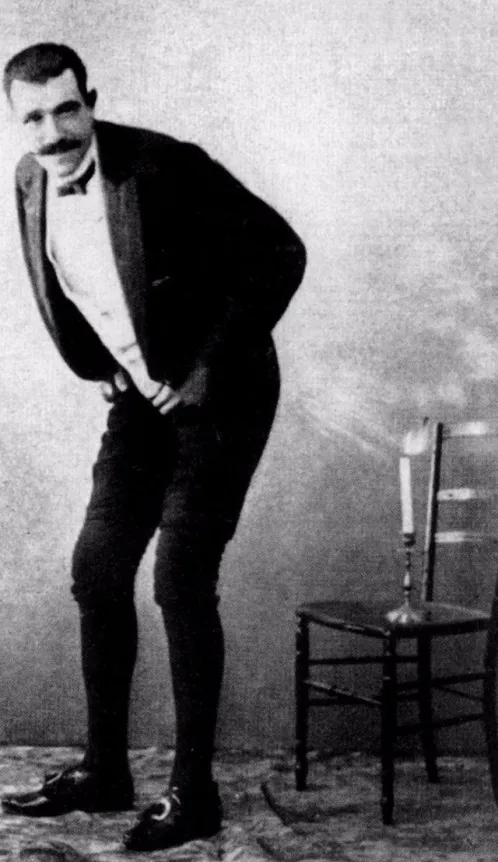
How Joseph Pujol Played the Moulin Rouge With His Butt?
Stretch the peach to change the sound.
An instrument using modern sound effects.
Joseph Pujol was a Marseille baker who became one of the most famous performers at the Moulin Rouge by learning to control air through his anus. Under the stage name Le Pétomane — a name formed from the French words péter, “to fart”, and maniaque, “maniac”, he could produce sounds that resembled cannon fire, thunder, animal calls, voices and torn cloth. He could change their pitch, volume and duration, and sometimes used a tube to direct the air into a small musical instrument.
The baker from Marseille
Pujol was born in Marseille on 1 June 1857. His parents came from Catalonia, and his father worked as a stonemason. Pujol trained as a baker and worked in the family trade. Show business was not entirely foreign to the family: his sister Louise became a music-hall singer, while two of his brothers, Marius and Louis, later helped with his theatre productions. He was one of five children. The ability that eventually changed his life appeared when he was still a boy.
The discovery in the water
In the account later given to doctors, Pujol said that he was about thirteen when he felt cold water enter through his anus while swimming near Toulon. Alarmed, he returned to shore and discovered that he could expel it again. He repeated the trick in the sea and later in a reservoir, gradually learning how to draw in and release water.
During his military service, he demonstrated the trick to friends. He then discovered that he could do something similar with air. By controlling the muscles around the opening, he could draw in ordinary air and release it at will. At first, it was a private curiosity. As a baker, Pujol entertained customers by imitating musical instruments from behind the counter. In 1887, he began performing publicly in Marseille. The act attracted enough attention for him to tour southern France before he eventually took it to Paris.
What the doctors observed
The clearest contemporary description of Pujol’s technique comes from a medical report published in 1892 by Marcel Baudouin. The report anonymised him as “P…”, but identified him through his age, birthplace, work at the Moulin Rouge and the details of his demonstrations. Doctors examined him in a Paris medical laboratory associated with Charles Richet and Dr Poirier. They described Pujol as a healthy thirty-five-year-old man with no hernia, malformation, digestive illness or unusual quantity of intestinal gas. What stood out was the strength and flexibility of his sphincter.
For the demonstration, Pujol leaned forward with his hands on his knees. He took a short breath, closed his throat and changed the pressure in his abdomen. External air entered through the anus. He then released it in a controlled stream, varying the sound by changing the pressure and tightening or relaxing the muscles involved. Baudouin recorded that Pujol could produce a loud sound ten or twelve times in succession. A single release could last between ten and fifteen seconds. He could imitate a bass voice, a violin, a trombone and several animal noises. During one demonstration, he extinguished a candle from a distance of roughly twenty-five to thirty centimetres. The doctors also watched him draw in about three-quarters of a litre of water and expel it in a jet that travelled several metres.
The report made an important distinction: the sound used in Pujol’s act came mainly from fresh air that he had drawn into his body, not from ordinary intestinal gas. That was why the performance did not carry the smell associated with normal flatulence. Baudouin gave the report a title almost as memorable as its subject: Un cas extraordinaire d’aspiration rectale et d’anus musical — “An Extraordinary Case of Rectal Aspiration and Musical Anus.”

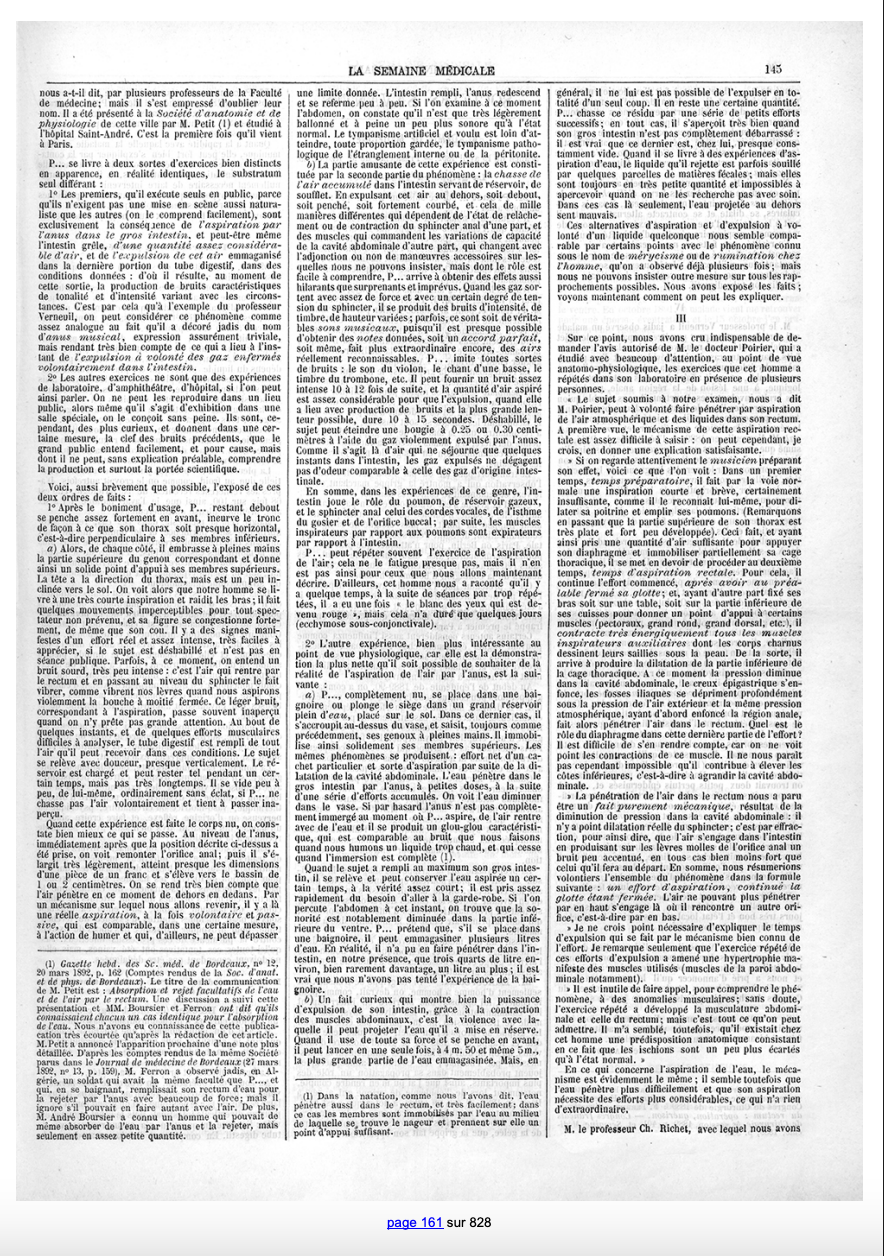
Source: La Semaine médicale, 1892, p. 145.
The photograph by Nadar
Baudouin returned to Pujol’s case in an 1898 report about another performer. He wrote that he and the photographer Nadar had made eleven photographs of Pujol: six showing the stages of drawing in and expelling air, and five showing a cigar experiment. One of the surviving figures is captioned “Expérience du cigare (Nadar).”
 Open the full-size scan ↗
Le Pétomane at the Moulin Rouge
The Moulin Rouge had opened in 1889 under Joseph Oller and Charles Zidler. Its outdoor stage already hosted dancers, singers, comedians and circus-style acts.
Zidler hired Pujol, who performed regularly at the Moulin Rouge between 1892 and 1894. His stage was outside, near the famous giant elephant, rather than in the main auditorium.
Pujol dressed like a respectable gentleman, often in a red coat and dark satin trousers. He bowed to the audience, arranged himself with complete seriousness and performed each sound as though he were playing a classical instrument. He did not behave like someone embarrassed by what he was doing. That seriousness was part of the act.
The published descriptions also mention routines built around a mother-in-law, a bride on her wedding night and the morning after, and different animal calls. Pujol sometimes used a small rubber tube to direct the air into an ocarina or another simple wind instrument. He performed tunes including Au Clair de la Lune, Le Bon Roi Dagobert and La Marseillaise. The instrument produced the notes; he supplied and controlled the air.
He became one of the Moulin Rouge’s best-paid performers and reportedly earned 20,000 francs per evening. A Moulin Rouge poster reportedly joked that he was “the only artist who paid no authors’ rights.”
The contract dispute
Pujol’s relationship with the Moulin Rouge ended in 1894. He performed independently to help a friend who was in financial difficulty, and the Moulin Rouge argued that he had broken his contract. The theatre took him to court. Pujol lost and was ordered to pay 3,000 francs. He then established his own company, the Théâtre Pompadour, and took the act on the road. His shows continued outside the Moulin Rouge, with members of his family and other performers involved in the productions.
La Femme-Pétomane?
In 1898, the Moulin Rouge presented a female performer billed as La Femme-Pétomane. The original medical report gives only the initials “Mme T…”. Marcel Baudouin encountered her at the Moulin Rouge and published his findings in Un nouveau cas d’aspiration rectale et d’anus musical chez la femme. He wrote that she had first believed her ability was an illness. After a friend told her about Pujol, she watched him perform, practised at home and eventually entered the same profession. She had begun performing in Lyon, was married with five children and said that she worked to support her family.
Baudouin observed her drawing air in through the anus and releasing it as sounds of different pitch and intensity. He considered her less powerful and less controlled than Pujol, but he was describing a real physical skill. She also used a rubber tube for a cigarette-and-smoke demonstration. Her claims about drawing in and expelling large amounts of water were not verified.
Baudouin also noted that she was involved in a lawsuit with an artistic newspaper. This may be the source of later stories about a defamation case, although the legal record has not been located.
When Pujol became a comic type
Pujol’s name was already being borrowed in print by the 1890s. A 1893 comic monologue was titled Le Ventomane, and another publication used the title Pétomane par amour!. Alison Moore’s research also cites a 1893 issue of L’Aurore Montmartroise whose title page announced that it had appeared “to erase the memory of the Pétomane.” Baudouin later claimed that his 1892 medical report had inspired a song by the writer Vincent Hyspa. Pujol’s name was now being used for songs, sketches and caricatures that did not involve him directly.
Out of fashion
Pujol continued performing into the early twentieth century, but the novelty eventually faded. By 1906, a contemporary writer noted that his speciality was no longer fashionable. He tried to soften the act. One later routine involved reading a poem about farm life while providing the sounds of the animals himself. The material was gentler, but the method had not changed.
The First World War brought his stage career to an end. Pujol returned to baking and later opened a biscuit factory in Toulon. He died in 1945 at the age of eighty-eight.
What survives
There is no known recording of Joseph Pujol performing.
A silent film from around 1900 is often associated with Le Pétomane du Moulin Rouge, but it preserves only the sight of the performer. It cannot tell us what his act sounded like.