

Peter Cusack: A life in field recording
Can you hear danger?
Peter Cusack on birdwatching, improvised music, favourite sounds, dangerous places and the patience of recording.
Peter Cusack is a field recordist, musician and sound artist who has spent decades working across improvised music, environmental recording and research. He began recording outdoors in the late 1970s and has since documented wildlife, cities and changing landscapes.
On birdwatching
What first drew you towards sound?
I became interested in improvised music in London in the 1970s, or even before that. That is the kind of music I like to play and have become known for.
At the same time, I was always interested in the environment. I was a birdwatcher as a child and learned to recognise birds through their songs and calls. So when it became possible to make recordings outdoors, the first thing I wanted to do was record birds and animals.
When did you first begin recording outdoors?
I started in the late 1970s, when I was a student in the Netherlands. I was doing a course in sonology, and there was an institute at the university that had a portable recorder, so I used that for making field recordings. But as soon as you start recording birds, you realise there is a whole range of other sounds going on all the time. Most of them are louder than the birds: aircraft, traffic and people. So, of course, you record those too. That is how I became interested in the whole sound environment, and that has been my interest ever since.
On music
How did music shape the way you listened to the sounds around you?
Musique concrète, which developed in the late 1940s, used environmental sounds and field recordings as material for making music. I listened to that and thought, perhaps I could do something like it. I slowly began using sounds in music, but I also kept an interest in environmental issues. The musical work and the environmental work have always existed alongside each other.
On listening to a place
When you arrive somewhere, what can sound tell you about it?
Sound gives you far more information about where you are than you pay attention to. People who are blind can find their way around very well through hearing. I am learning how to do that, but it is definitely possible. Even when we rely on sight, we learn a huge amount from what is happening around us through our ears. We do not pay much conscious attention to it most of the time, but we are still taking in a lot of information.
On favourite sounds
In his Favourite Sounds Project, Cusack asks people which sounds from their everyday lives matter most to them.
What did you expect people to name when you asked them for a favourite sound?
When I first started, I expected people to mention Big Ben or the bells of St Paul’s Cathedral, obvious London sounds, the city’s iconic soundmarks. Almost nobody said those things.
They talked about sounds at home, in their gardens, in their local pubs or while travelling from home to work or school. The sounds were much more local and much more individual than I expected. I have done the project in many cities around the world, including Beijing, and it has always been the same. People remember and talk about sounds that are close to their own lives.
Do you believe these sounds reveal something about the people who choose them?
People mention sounds connected to cooking, or, if they are football fans, the sound of Spurs scoring against Arsenal at White Hart Lane. It is very varied. The important part is not only what the sound is, but why it is someone’s favourite. Once people explain that, you learn about their personal tastes, their history and the kind of person they are.
It also shows how differently people experience a place. Someone who grew up somewhere else may have a completely different soundscape from someone who grew up in London. Moving from one place to another can be a kind of sonic culture shock.
What is your favourite sound?
It keeps changing. I do not think anybody has one favourite sound. They think of something at the time you ask, and if you ask them the next day, it might be something else.
I like the sounds of the London Underground. But a lot of people do not give one sound; they like a particular mix of sounds at a particular place. That is true for me as well.
My favourite place in London is along the Lee Valley, around Walthamstow Marshes. There are always trains, but no major roads, so the traffic is not too loud. Then there is the canal, wildlife, people walking, dogs and everything else happening around them. The bottom of Springfield Park is another place that always sounds interesting to me. Of course, it changes over the years because the soundscape is constantly changing.
On dangerous places
Sounds from Dangerous Places takes him to sites shaped by pollution, industry and environmental damage.

What did the oil fields around the Caspian Sea sound like when you first recorded them?
I came into all of this from an experimental music background, so I tend to like sounds that many people would not consider musical.
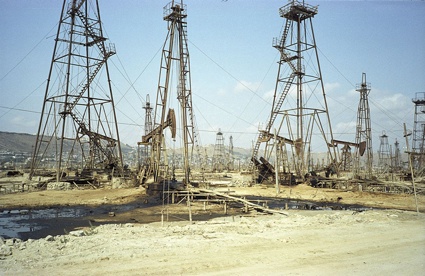
When I first went to the oil fields around the Caspian Sea, there were hundreds of oil derricks moving up and down. They were old, built during the Soviet period, and each one had its own squeak and groan. You could hear many of them at the same time, and to my ear it sounded very musical. The local people hated it, but I loved it. It was a beautiful sound in a very dangerous place, dangerous because of the pollution and because of its geopolitical impact.
Recording by Peter Cusack · Sounds from Dangerous Places ↗
This recording could not load. You can listen on the source page above.
Recording by Peter Cusack · Sounds from Dangerous Places ↗
This recording could not load. You can listen on the source page above.
Recording by Peter Cusack · Sounds from Dangerous Places ↗
This recording could not load. You can listen on the source page above.
What did you hear in Chernobyl?
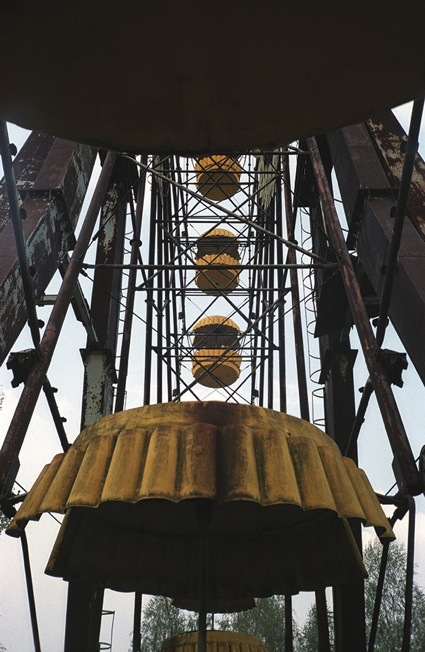
It was not quite as musical as an oil field, but there were plenty of sounds. When people were moved out, wildlife moved back in. The dawn choruses were full of sound and full of different species—much richer than the dawn choruses in most places where people live.
It was a beautiful wildlife sound, but it existed because of one of the world’s worst nuclear accidents. The sounds you hear are not necessarily dangerous to hear. They give you information about the place and about the dangers that exist there.
On Chernobyl
Chernobyl became one of the project’s most striking locations, where birds and wildlife existed alongside the traces of nuclear radiation.
Was there a moment when a recording made a connection you had not expected?
There is one recording with a cuckoo and a guide’s radiometer clicking at the same time. There are a lot of cuckoos in Chernobyl, but I made a more poetic connection between the two sounds.
The cuckoo lays its egg in another bird’s nest. When the egg hatches, the chick pushes the other eggs or chicks out, and the host parents feed it as if it were their own. Radioactivity dispersed people from Chernobyl. In some way, I saw a connection between the cuckoo and the radiation. They both destroy a way of life for another species.
Recording by Peter Cusack · Sounds from Dangerous Places ↗
This recording could not load. You can listen on the source page above.
Could you hear the radiation itself?
No. The sarcophagus is designed to protect you from radioactivity, and it does its job. There was no noticeable increase in radiation that I could hear.
When the accident happened, the radioactivity fell back down in patches. There could be a high concentration in one place and almost nothing 50 metres away. There were hot spots and cold spots all over the area. Then, when the wind blew, the hot spots could move. If you mapped them one week, the map could be different the following week. You needed a Geiger counter to find your way because you could suddenly come across a new hot spot. I am talking about twenty years ago, so everything will have changed and become much less radioactive by now. But radiation decays over a very long period of time.
Recording by Peter Cusack · Sounds from Dangerous Places ↗
This recording could not load. You can listen on the source page above.
What did you learn about Chernobyl beyond the sounds themselves?
Some people were affected very badly, while others seemed not to be affected at all. I met people who told me they had stayed there the whole time.
Most people were evacuated, but some refused to leave. They hid in the forest and later came back. Three or four years afterwards, people who had lived there all their lives were allowed to return legally in some parts of Ukraine and Belarus. In other areas, nobody was allowed back. It depended on the local policies of the different countries involved.
On returning to a place
What makes you want to record somewhere again?
I am interested in environmental changes, and those happen over long periods of time. They also depend on the season. If you are interested in birds singing, for example, many of them only sing in spring, so you have to wait until the following year. I would be interested in recording the oil fields again, just to hear how they have changed.
Is there somewhere new that interests you now?
I guess I would like to record a rainforest. I have never been to a tropical rainforest in Amazonia, Africa or Indonesia.
I am also interested in East Suffolk, where I go quite often. It is being reindustrialised as an energy hub. Solar farms are being built, cables from offshore wind farms are coming ashore, and they are constructing a new nuclear reactor at Sizewell. They are building new networks to carry green energy across the country, but it is also very disruptive to that particular area. There is a huge amount of activity, and it is changing the soundscape. I hope to document it over the next few years. My brother lives there, so I go there often and it is somewhere I can actually return to.
On waiting
What does a recording actually involve? Has it changed over the years at all?
It has not changed at all. You always have to wait, sometimes for days, for a particular sound to happen. That is especially true with birds. They can choose to sing whenever they want, and it is often not when you happen to be there with a recorder ready. There are certain birds I have tried to record and have never succeeded in recording in my lifetime because I was never there at the right time, or they were not singing when I was there.
It can happen with ordinary sounds too. If you want to record an announcement on the London Underground saying there is a good service, you may have to wait a long time. On some days, there is no good service, so the announcement is never made. Environmental sound is unpredictable. If you go intending to record one particular sound, the chances are you will not succeed because it will not happen while you are there. Even if you are in the middle of recording, a plane might fly over and change the whole thing.
What happens when the sound you were waiting for never arrives?
You do not control the situation. You are dependent on what is happening at that moment. But if you record what is actually there, you will capture sounds you were not expecting. At some point, you might be glad you have them. And if it is not what you were after, that is your problem, not anybody else’s.